AI assistant or meal planner? What makes Cauli different
A general AI assistant can write you a meal plan, and a good one. Cauli is built for a different job: it decides how every meal of your week happens around your busy nights, computes every number from food data, checks allergies in code, keeps what it learns about your eating where you can see it, and turns the week into a plan you follow, not a chat you restart.
Key takeaways
- How each meal happens: every meal is a Cook, a Batch or a Leftover, planned around the nights you can't cook.
- Numbers with a source: computed in code from USDA FoodData Central or the product's label, never written by a model.
- Allergies in code: checked by allergy family on every ingredient and product; when Cauli can't tell, it treats the food as unsafe.
- Memory you can see and a week that learns from what you save, skip and swap.
- A weekly habit: a one-minute Weekly Reset, one tap of Ate it, a Streak counted in weeks.
The five differences at a glance
| A general AI assistant | Cauli | |
|---|---|---|
| Nutrition numbers | Written by the model; often close, with no source to check | Computed in code from USDA data or the label; every day within 5% of your calories |
| Allergies | Follows your instructions | Checked in code by allergy family; an unclear ingredient counts as unsafe |
| Memory | Remembers across everything you use it for | Only your eating, in plain sentences on one screen; delete any line |
| Learning | From what you tell it | From Save, Never again and its reason, Swaps, Won't eat and Leans; the Week says why it chose something |
| The week | A plan in a conversation; ask again when it changes | A decided Week on your phone: Weekly Reset, Ate it, a Streak and progress toward your goal |
Start with how each meal happens
Most meal plans are a list of recipes. Cauli plans the shape of the week first. Every meal is a Cook (made fresh), a Batch (cooked once for several meals) or a Leftover (from an earlier Batch). A Batch says what it feeds: "makes 4: tonight, Tue lunch, Wed dinner". Busy nights get a Leftover, a quick Cook of about 10 to 20 minutes, or a product you saved. Cauli never adds store-bought food on its own.
That plan comes with one grocery list for the week, by store and aisle, that always matches it. More in the batch cooking guide and planning a busy week.
1. Numbers with a source
Every ingredient in a Cauli meal is matched to a USDA FoodData Central record (the Foundation Foods and SR Legacy data sets, kept in Cauli's own database), and each meal's calories, protein, carbs and fat are multiplied out in code from the grams in the recipe. A branded product uses its own label: found by barcode in label databases, or read from a photo of the label you take. A model helps write the dishes. It never estimates a number.
Because the numbers are computed, Cauli can hold every day to your target, within 5% of your calories with protein close behind, and recompute when anything changes. When you ask to move a meal, the Proposal shows the new numbers before you confirm. See Methods and sources.
We tested general models. They were close.
We asked three current models, through their APIs, for a one-day high-protein plan at 2,200 kcal and 180 g protein, with grams and nutrition for every ingredient. Three runs each, the same prompt. Then we recomputed every ingredient from USDA FoodData Central with Cauli's own nutrition code.
| Model | Calories: stated / computed | Protein: stated / computed |
|---|---|---|
| GPT-6.1 Sol | 2,200 / 2,196 (0.3% apart) | 180.0 g / 177.9 g (1.2% apart) |
| Claude Sonnet 5.5 | 2,197 / 2,187 (0.4% apart) | 182.4 g / 179.3 g (1.7% apart) |
| Gemini 4 Argon | 2,205 / 2,203 (0.2% apart) | 180.0 g / 176.8 g (1.8% apart) |
All nine plans were within 1% of their stated calories and 3.7 g of their stated protein, and every plan's items added up to its own total. On a simple whole-food day, these models did the arithmetic well. Most of the protein gap came from which food record fits best (rolled oats and whey powder vary), not from mistakes.
What we didn't test: the consumer agents themselves (Claude Duet, ChatGPT Dots, Meta Muse, Instinct), mixed dishes, restaurant meals, branded products, or a plan that changes through the week. One day, nine runs, JSON output requested. So the honest difference is not that assistants get the math wrong. It's that Cauli's numbers come from a record you can trace, are recomputed every time the plan changes, and are held to your target every day without you checking.
2. Allergies checked in code, not by the model
You set allergies by family: milk, eggs, fish, crustacean shellfish, molluscs, tree nuts, peanuts, wheat, gluten, soy and sesame. Code checks every food against them: each ingredient's reviewed allergy families plus the family's written list of foods, following FDA allergen guidance. The model never decides whether something is safe.
- When Cauli can't tell, it says no. An ingredient that can't be shown free of your allergen is treated as containing it.
- Products: a "may contain" or shared-facility line on the label counts. If the label can't be read, Cauli asks for a photo of the allergen panel first.
- Your own recipes: a recipe with an allergen on your list is never saved as written.
Allergies are absolute. They aren't preferences Cauli learns or weighs against anything else.
3. Memory you can see and edit
General assistants remember too. The difference is scope and visibility. Cauli's memory is only about your eating, and it lives on one screen, What Cauli knows, in plain sentences:
- Your basics: allergies, equipment, who you cook for.
- Standing instructions: "Overnight oats every weekday breakfast".
- Won't eat: "Mushrooms".
- Leans: "Chicken thighs over breast", "Less rice until October".
- Things Cauli has noticed: "Keeps weeknight dinners quick".
- Won't suggest again: meals you marked Never again, with the reason.
You can delete any line. What you told Cauli stays until you delete it; a line Cauli noticed fades after about 12 weeks with nothing new behind it.
4. A week that learns
Cauli learns from what you already do in the app: meals you Save, meals you mark Never again and why (not for me, too much effort, not filling), the Swaps you make, your Weekly Reset grid, and what you tell it in the chat. What you say plainly ("no mushrooms", "more spice") is saved right away as a Won't eat or a Lean. A pattern is kept as a noticed line only when at least three signals across at least two Weeks agree, so one odd week doesn't reshape your plans. It never notices anything about your body or mood, only food, effort, fullness and variety.
Every line shapes the next plan, and when one changes a choice, the Week says so in a few words: "Quick Tuesday: you keep weeknights short".
5. A plan you follow, not a chat you restart
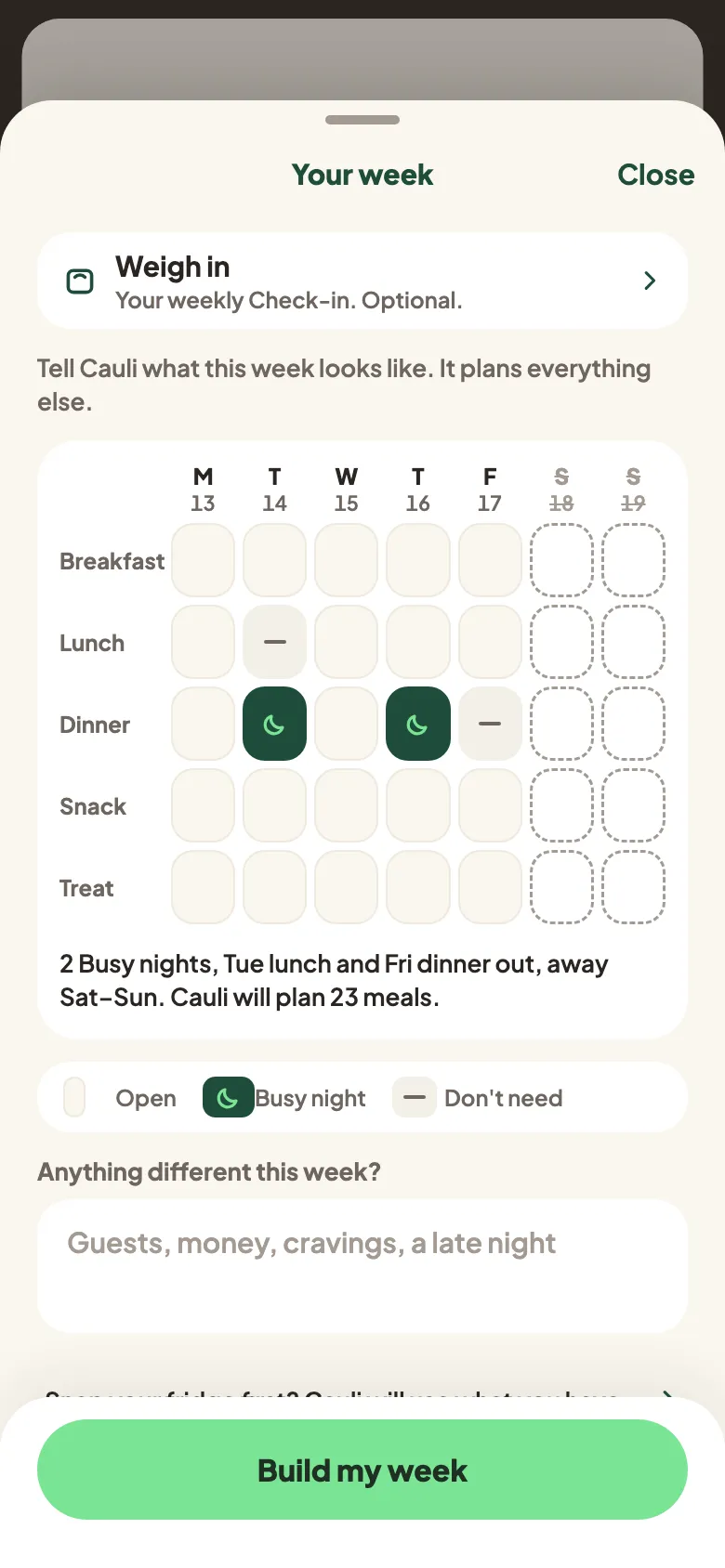
- Weekly Reset: once a week, on your day, mark which meals are busy or not needed on a pre-filled grid. Cauli builds the Week. Nothing is live and nothing is bought until you confirm.
- Ate it: one optional tap per meal instead of logging. Your day's numbers update.
- Streak: counted in weeks, not days. A week counts when you tap Ate it on at least 70% of its meals, so one bad day never breaks it.
- Progress: your weight trend toward your goal. After the weekly Check-in, if you're off pace, Cauli proposes new targets for you to confirm.
- Changes: tell Cauli "Thursday's a late night" and it proposes the change across the Week and the grocery list. Nothing moves until you confirm.
When a general assistant is the better pick
- You want one plan, once, or ideas for a dinner party.
- You want food ordered or delivered. Cauli doesn't order groceries.
- You need Android, or you live outside the US.
- You need a medical diet. Cauli is a planning tool, not medical advice.
Your AI assistant can write a meal plan. Cauli runs your eating week.
Cauli is on the App Store for iPhone (iPad supported), in the US and in English, for people 16 and over, as a subscription through the App Store with no free trial.
Questions people ask
Can't my AI assistant just plan my meals?
It can write a good plan when you ask, and current models get the calories close on a simple day. What a general assistant isn't built for is running the week: deciding how each meal happens around your busy nights, keeping one grocery list in step, checking allergies in code, and getting better at your eating from what you save, skip and swap. That's Cauli's whole job.
Are AI calorie numbers accurate?
In our November 2026 test, GPT-6.1 Sol, Claude Sonnet 5.5 and Gemini 4 Argon each wrote a 2,200-calorie, 180 g protein day three times. Recomputed from USDA FoodData Central, every plan was within 1% of its stated calories and within 3.7 g of its stated protein. The difference with Cauli is not arithmetic; it's that every Cauli number is computed from a named food record and recomputed whenever the plan changes.
Does Cauli use AI?
Yes. A language model helps compose dishes and understands what you tell it in the chat. It never supplies a number, and it never decides whether a food is safe for an allergy. Both are done in code.
Can I see what Cauli remembers about me?
Yes. What Cauli knows lists everything in plain sentences: your basics, Standing instructions, foods you won't eat, your Leans, what Cauli has noticed and what it won't suggest again. You can delete any line.